
Chronic back and neck pain sends millions of people searching for an alternative to surgery, injections, or long-term medication. Spinal decompression therapy is frequently marketed as that alternative — a gentle, non-invasive way to relieve pressure on compressed discs and pinched nerves. But does it actually work, or is it an expensive placebo dressed up in clinical language?
The honest answer sits somewhere in the middle. Spinal decompression therapy has a plausible mechanism, a growing body of small clinical studies, and many patients who report real relief. At the same time, independent reviewers have repeatedly pointed out that the evidence base is thin, the studies are small, and no large-scale, gold-standard trial has definitively proven its superiority over cheaper conservative treatments.
What Is Spinal Decompression Therapy?
Spinal decompression therapy comes in two distinct forms, and conflating them is one of the biggest sources of confusion online.
Surgical decompression is a procedure performed by a surgeon to physically remove material pressing on the spinal cord or nerve roots — for example, a laminectomy or discectomy. This is reserved for severe cases involving significant nerve damage, progressive weakness, or loss of bladder or bowel control, and its effectiveness for those specific indications is well established in the surgical literature.
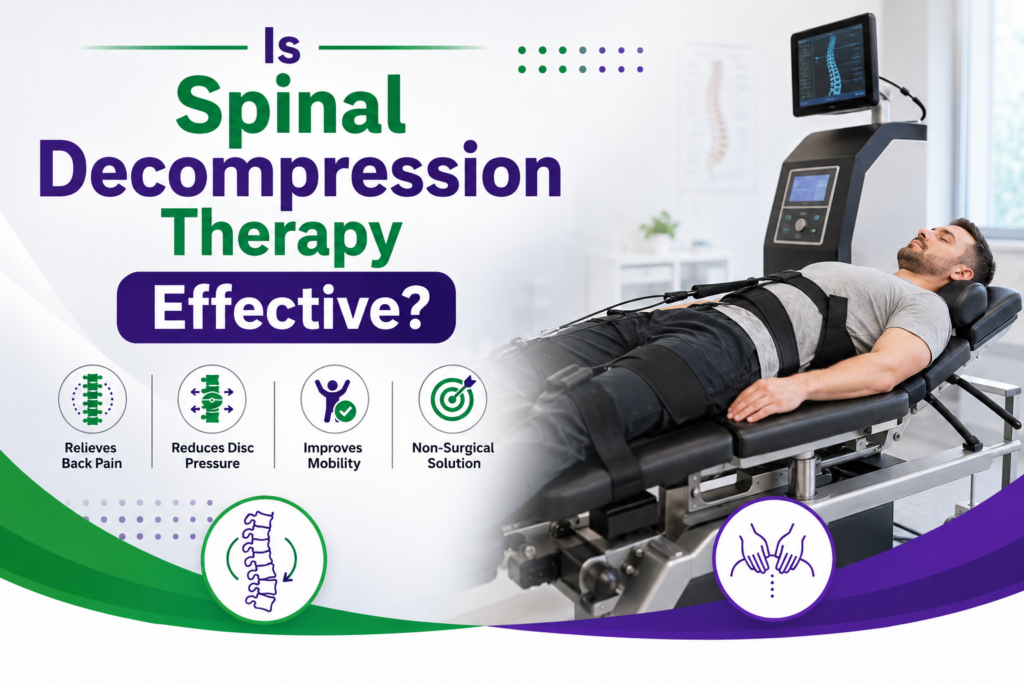
Non-surgical spinal decompression (NSSD) is what most people mean when they ask about “spinal decompression therapy” at a chiropractic or physiotherapy clinic. It uses a motorized traction table that gently stretches the spine in a controlled, intermittent cycle. The goal is to reduce pressure inside the intervertebral discs, encouraging bulging or herniated disc material to retract slightly and creating more space for compressed nerves. This article focuses primarily on the non-surgical version, since that’s the treatment most commonly advertised for chronic low back and neck pain.
Read more : Spinal Decompression Therapy: Complete Guide, Benefits & Risks
How Does It Work?
During a typical session, you lie on a computerized traction table while a harness is secured around your pelvis or torso. The machine applies a slow, cyclical pulling force — stretching for a set period, then easing off — rather than a constant pull. This intermittent pattern is meant to lower pressure inside the disc (sometimes called negative intradiscal pressure), which may help draw in nutrients, reduce inflammation, and take pressure off nearby nerve roots. Sessions usually last 20 to 45 minutes, and a full treatment course often runs 15 to 30 sessions over four to eight weeks, frequently paired with laser therapy, electrical stimulation, or targeted exercise.
What Does the Research Say About Effectiveness?
This is where it pays to look past the marketing copy on clinic websites and toward the underlying science.
The case for effectiveness
Several smaller studies and case series have reported encouraging outcomes. Retrospective chart reviews of patients undergoing non-surgical spinal decompression for chronic low back pain have documented meaningful reductions in pain scores and improvements in daily function after a full course of treatment. Some imaging-based studies have gone further, using MRI or CT scans before and after treatment and reporting measurable changes in disc height or herniation size alongside symptom improvement, suggesting the mechanism may do more than simply feel relaxing.
A 2025 case series examining patients with lumbar disc herniation who had not responded to standard conservative care found structural changes on imaging alongside symptom relief after an intensive multi-week protocol. Randomized trials comparing decompression added to standard physical therapy against physical therapy alone have also found added benefits in pain, range of motion, and quality of life for patients with lumbar radiculopathy (nerve-related leg pain from the lower back).
The case for caution
Despite these positive signals, independent reviewers have been consistently more reserved. A widely cited evaluation of the scientific literature concluded that the evidence available was limited and did not justify treating non-surgical spinal decompression as a routine, first-line treatment, especially given that less expensive, well-studied alternatives exist.
More recent reviews echo this: no Cochrane-level systematic review or large randomized controlled trial has yet established definitive efficacy, and authors regularly flag the same methodological weaknesses across the existing studies — small sample sizes, lack of blinding (which is difficult with any physical therapy), reliance on subjective pain scores, and treatment protocols that combine decompression with other therapies, making it hard to isolate which part of the treatment is actually responsible for improvement.
A 2025 retrospective review covering more than 260 patient records likewise noted that scientific support for the treatment, while growing, remains limited, and that this is part of why most insurance plans do not cover it.
In short: there’s enough evidence to say spinal decompression therapy isn’t snake oil, and enough patients report genuine relief that the treatment deserves a place in the conservative-care conversation. But there isn’t yet enough high-quality evidence to call it proven superior to standard physical therapy, exercise, or traditional traction for the average patient with low back pain.
Who Tends to Respond Best?
Based on the available studies and clinical reporting, the patients most likely to benefit share a few characteristics:
People with disc-related pain — bulging or herniated discs, degenerative disc disease, or mild to moderate nerve root irritation — appear to respond more consistently than those with pain stemming from arthritis, muscular strain, or non-specific causes. This type of pain often traces back to a specific event, such as a motor vehicle accident or a workplace injury, though it can also develop gradually from age-related wear. Patients who have already tried and failed more conservative measures like physiotherapy, anti-inflammatory medication, and activity modification are the typical candidates clinics target, since decompression is generally positioned as a step before considering injections or surgery. People without contraindications also matter: pregnancy, fractures, spinal fusion hardware, severe osteoporosis, tumors, or abdominal aortic aneurysm are standard reasons a provider would advise against this treatment.
How It Compares to Other Conservative Treatments
It helps to view spinal decompression therapy as one tool among several conservative options, not a stand-alone cure.
Traditional manual or mechanical traction has been used for decades and works on a similar principle, though without the computerized, variable-force control that decompression tables offer. Studies comparing the two have found mixed results, with some showing modest advantages for computerized decompression and others finding no meaningful difference. Targeted exercise therapy and physiotherapy consistently show at least moderate-quality evidence for chronic low back pain and are typically the first-line recommendation in clinical guidelines.
Spinal manipulation, offered by chiropractors and some physical therapists, has reasonable evidence for short-term pain relief in non-specific low back pain. Massage therapy is also commonly used alongside decompression to ease the surrounding muscle tension that often accompanies disc-related pain. Given the overlapping evidence, many practitioners now recommend combining decompression with active exercise and strengthening rather than relying on passive traction alone — addressing both the structural disc issue and the muscular imbalances that often accompany it.
Risks, Costs, and What to Expect
Non-surgical spinal decompression is generally considered low-risk. The most commonly reported side effect is mild, temporary soreness in the back or hips after a session, comparable to post-exercise muscle fatigue. Serious complications are rare but not impossible, particularly in patients with undiagnosed spinal instability or osteoporosis, which is why a proper evaluation and imaging review before starting treatment matters.
Cost is a significant practical consideration. Because the evidence base is still developing, most health insurance plans classify spinal decompression as not medically necessary or experimental, meaning patients often pay out of pocket.
A full course of 15 to 30 sessions can run anywhere from several hundred to a few thousand dollars depending on the clinic and region, so it is worth checking your extended health care coverage and asking providers directly about total expected cost before committing to a multi-week protocol.
The Bottom Line
Spinal decompression therapy is not a miracle cure, but it’s also not unfounded pseudoscience. The most accurate summary of the current research is that it appears to offer real, measurable benefit for a meaningful subset of patients — particularly those with disc-related low back or neck pain who haven’t responded to simpler conservative measures — while still lacking the large, rigorous, independent trials needed to confirm exactly how much of that benefit comes from the traction itself versus the accompanying exercise, attention, and time.
If you are considering it, a reasonable approach is to treat it as one option within a broader conservative-care plan, discuss your specific imaging and diagnosis with a qualified provider, ask about realistic timelines for reassessing progress, and avoid clinics that promise guaranteed results after a fixed number of sessions, since individual outcomes genuinely vary.
This article is for general educational purposes and isn’t a substitute for individualized medical advice. Anyone with new or worsening back pain, numbness, weakness, or bowel or bladder changes should see a qualified healthcare provider promptly.
Considering Spinal Decompression Therapy in Mississauga?
If you are weighing whether spinal decompression therapy is right for your back or neck pain, a proper assessment makes all the difference. At Pro-Active Physiotherapy Clinic in Mississauga, our team evaluates your imaging, history, and symptoms before recommending spinal decompression therapy on its own or as part of a broader plan that may include physiotherapy, chiropractic care, or massage therapy. Contact us for more information
Frequently Asked Questions
Is spinal decompression therapy proven to work?
It has moderate, growing evidence — including small clinical trials and imaging-based studies — but no large-scale, independent, gold-standard trial has definitively proven it superior to other conservative treatments. Many patients report meaningful relief, but results vary, and researchers consistently call for higher-quality studies.
How many sessions of spinal decompression therapy are usually needed?
Most protocols involve 15 to 30 sessions over four to eight weeks, typically scheduled two to three times per week. Some clinics use shorter intensive protocols; your provider should set expectations based on your specific diagnosis.
Does insurance cover spinal decompression therapy?
Usually not. Because the scientific evidence is still considered limited by many insurers, non-surgical spinal decompression is frequently classified as not medically necessary or experimental, so patients commonly pay out of pocket.
What conditions does spinal decompression therapy treat?
It is most commonly used for bulging or herniated discs, degenerative disc disease, sciatica, and mild to moderate nerve root compression in the neck or lower back. It is not appropriate for fractures, spinal tumors, severe osteoporosis, or pregnancy.
Is spinal decompression therapy safe?
For appropriately screened patients, yes — it is generally low-risk, with mild, temporary soreness being the most common side effect. Serious complications are rare, particularly when a provider properly screens for contraindications beforehand.
